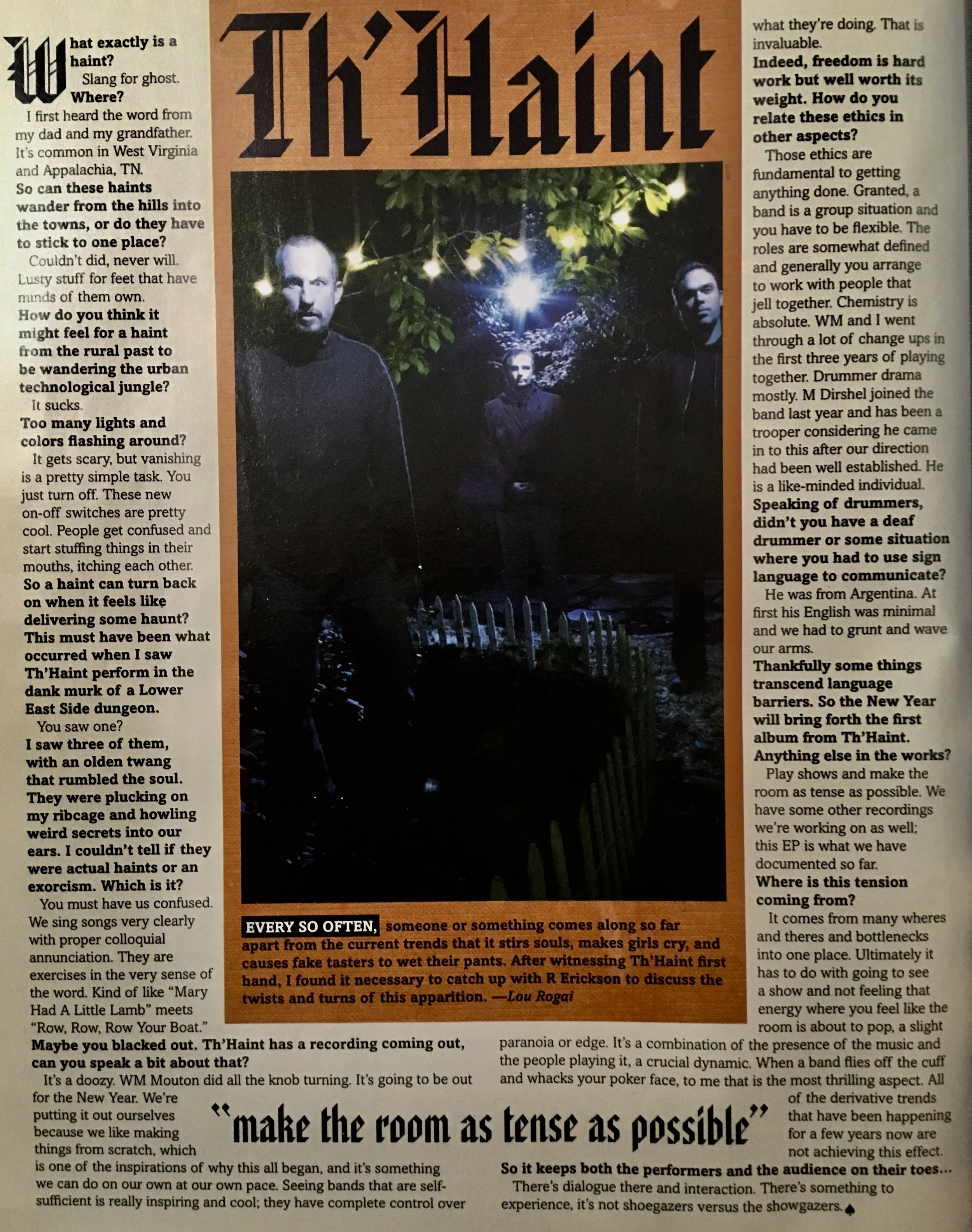
Thrasher Magazine - February 2006 - Interview with Rob Erickson of Th’Haint
Every so often, someone or something comes along so far apart from the current trends that it stirs souls, makes girls cry, and causes fake tasters to wet their pants. After witnessing Th'Haint first hand, I found it necessary to catch up with R Erickson to discuss the twists and turns of this apparition. -Lou Rogai
What exactly is a haint?
Slang for ghost.
Where?
I first heard the word from my dad and my grandfather. It's common in West Virginia and Appalachia, TN.
So can these Haints wander from the hills into the towns, or do they have to stick to one place?
Couldn't did, never will. Lusty stuff for feet that have minds of them own.
How do you think it might feel for a haint from the rural past to be wandering the urban technological jungle?
It sucks.
Too many lights and colors flashing around?
It gets scary, but vanishing is a pretty simple task. You just turn off. These new on-off switches are pretty cool. People get confused and start stuffing things in their mouths, itching each other.
So a Haint can turn back on when it feels like delivering some haunt? This must have been what occurred when I saw Th'Haint perform in the dank murk of a Lower East Side dungeon.
You saw one?
I saw three of them, with an olden twang that rumbled the soul. They were plucking on my ribcage and howling weird secrets into our ears. I couldn't tell if they were actual haints or an exorcism. Which is it?
You must have us confused. We sing songs very clearly with proper colloquial annunciation. They are exercises in the very sense of the word. Kind of like "Mary Had A Little Lamb" meets "Row, Row, Row Your Boat."
Maybe you blacked out. Th'Haint has a recording coming out, can you speak a bit about that?
It's a doozy. WM Mouton did all the knob turning. It's going to be out for the New Year. We're putting it out ourselves because we like making things from scratch, which is one of the inspirations of why this all began, and it's something we can do on our own at our own pace. Seeing bands that are self-sufficient is really inspiring and cool; they have complete control over what they're doing. That is invaluable.
Indeed, freedom is hard work but well worth its weight. How do you relate these ethics in other aspects?
Those ethics are fundamental to getting anything done. Granted, a band is a group situation and you have to be flexible. The roles are somewhat defined and generally you arrange to work with people that jell together. Chemistry is absolute. WM and I went through a lot of change ups in the first three years of playing together. Drummer drama mostly. M Dirshel joined the band last year and has been a trooper considering he came in to this after our direction had been well established. He is a like-minded individual.
Speaking of drummers, didn't you have a deaf drummer or some situation where you had to use sign language to communicate?
He was from Argentina. At first his English was minimal and we had to grunt and wave our arms.
Thankfully some things transcend language barriers. So the New Year will bring forth the first album from Th'Haint. Anything else in the works?
Play shows and make the room as tense as possible. We have some other recordings we're working on as well; this EP is what we have documented so far.
Where is this tension coming from?
It comes from many wheres and theres and bottlenecks into one place. Ultimately it has to do with going to see a show and not feeling that energy where you feel like the room is about to pop, a slight paranoia or edge. It's a combination of the presence of the music and the people playing it, a crucial dynamic. When a band flies off the cuff and whacks your poker face, to me that is the most thrilling aspect. All of the derivative trends that have been happening for a few years now are not achieving this effect. So it keeps both the performers and the audience on their toes ... There's dialogue there and interaction. There's something to experience, it's not shoegazers versus the showgazers.

Forward: Famous Last Words - Aaron Ross - 2023
“You’ll meet my friend Aaron, you’re going to love him, his songs are really something special”.
I was visiting Nevada County sometime around the turn of the last century. A friend from back east was renting an efficiency cabin in Cedar Ridge, nestled between Nevada City and Grass Valley.
“Here, this is Aaron’s album, put this on.” I held a homemade CDR with a distorted xerox photo of someone’s face, presumably the artist’s. I became transfixed by a lo-fi recording that filled the small room with fervorous strumming. It was the voice that struck me, spouting couplets with haunting urgency. This voice was both refreshingly new and strangely familiar, feeling like home.
There are certain voices reserved for legendary artists. I’m talking about the ones our parents grew up listening to; the woodstock-headlining, both sides now, the fourth, the fifth, the minor fall major lift-hallelujah voices. This was that kind of voice, delivering raw poetry. I remember saying, “people don’t make music like this anymore.” My friend looked at me and smiled: “Aaron’s coming over, let’s make some music.” And so began our introduction, as Aaron showed up with his guitar and we lit up the night on Cedar Ridge.
The following year I was touring again in the Bay Area. I invited Aaron to play with me at the Hemlock, discovering he’d never played SF before. A surprise, considering what a treasure he was to those in his tight-knit community just a few hours north. It was also early on in both of our journeys and we were excited for just about anything. “I said dear mother there’s so much I gotta see but I haven’t seen Detroit or the San Francisco Bay” (“With Only My Pride”).
We kept in touch over the years and played shows together whenever I was in town. I recorded his song “The Comfort Inn”, motivated by a strong conviction to tell his story and put his name in as many ears as possible. It’s one’s duty as a true believer to share the gospel. I remember him coming to NYC and PA and finally getting to spend some time on the East Coast together and play a few shows. He came through with Hella too. I was always intrigued to see Aaron stretch out artistically, and eager to hear what he’d do next. It’s particularly cool to see someone you admire making strides as an artist in a kind of parallel dimension from similar starting points.
This Book represents a body of work spanning nearly two decades. Ross as songwriter and narrator continues to weave his magic with the same organic wisdom he began with. His singular voice is the through-line to a road well-traveled, venturing in and out of stranger territory and conjuring more nefarious characters. We hear an authenticity when he sings of the poets, as he walks among them. Observer and instigator, he scornfully points to clues, pulling back the curtain and giving us all a closer look, mostly at ourselves. Aaron Ross is letting us in on his well-kept secret; his everyman’s story, part myth, part legend, a humble treasure from the foothills of the Sierra Nevadas.
-Lou Rogai
November 2022
Delaware Water Gap, PA

Liner Notes: Strand of Oaks - Leave Ruin Western Vinyl / La Société Expéditionnaire 2020
I heard about a new guy in town. He was attending the University and grew up in Indiana. Thomas said his name was Tim, he said that I would like his songs. They sounded like Red House Painters on banjo and steel string guitar.
We ended up meeting some time later at the local punk/art-house venue. He sat down when he played his songs which at that time had no real beginnings and no real endings, the guys jamming along intuitively. Thomas was right. I could feel something powerful beneath his voice, shaky but beautiful. I noticed how he was unsure if the slight Indiana drawl coming out of his mouth actually was his own. He was raw and green, and going for it. His playing was simple but solid, and there was a magic to it all which was clearly the sum of its parts: really great songs. I was drawn in and wanted to inhabit them with him. To me that's the biggest compliment a songwriter can be payed.
I would soon find out that he had relocated to Northeastern PA for school after a bad breakup. He grew up around church people and he loved basketball and indie rock. He told me that his coach had mocked his limp, and he didn't want to be a doctor like his brother who he admired. His father and grandfather were businessmen, one of them owned the local Buick dealership. His mother was a school teacher who loved to sing. They all were characters and scenarios he sang about, painting a picture of a guy breaking away from middle America and figuring things out for himself.
I heard he had recorded in our friend Mark's basement that also served as a house venue. Tim handed me what was his first release on CDR, the cover was drawings and handwriting: "Alma". That was the name of his grandmother. The songs sounded like his live set, no real beginnings or endings, but strikingly good in the middle. He told me they were demos, really. I offered to bring him to the studio where I had been recording. We agreed that I would produce and oversee the recording and release of what was to become Leave Ruin.
The rest became a blur as we became deeply entwined. He was teaching elementary school full time. I was launching my label with his 7" as the first release, "45 Today". I played piano on it, and as I write this I realize that I am forty five years old. It seemed so far away then. I was touring a lot and we were playing a lot of shows together. I booked a 10 day tour for us in New England and Tim drove. We talked and listened.
On that tour of New England we played in an enormous vintage bookstore. I found a dusty old copy of my favorite childhood reader, Faraway Ports. It contained a story called "Timothy's Antlers" about a young deer, eager to become a buck. He goes off into the wild, looking for his own antlers to no avail. With the spring thaw he returns to see his reflection in the water. Unbeknownst to him, he had grown his antlers. I purchased the book to give to Tim and scrawled a note inside with some sort of metaphor about antler-finding being akin to coming into our own, musically speaking.
Over the next couple of years, we kept chipping away at the studio recordings when players and studio time became available. The album took shape slowly, not only due to scheduling, but also to allow acclimation for both the studio environment and the songs themselves. The songs had too much weight to be a quick affair. Tim was rising to the task in the studio, his voice growing more confident with each session, and trusting his gut with the theory that the first takes are the best takes.
Our friendship grew, we were allies, colleagues and confidants. I was the best man in Tim's wedding, my son Julian ring-bearer. I watched Tim grow into himself just after Leave Ruin was finally released in 2009. We both realized what he had been searching for, the kind of obvious thing you don't notice growing until it appears in full bloom. Timothy had discovered his own antlers.
Lou Rogai
July 9, 2019
Delaware Water Gap, PA
USA